On the Lung Transplant Waiting List
Posted on Tuesday 3 November 2020 Reading time: 4.5 minute
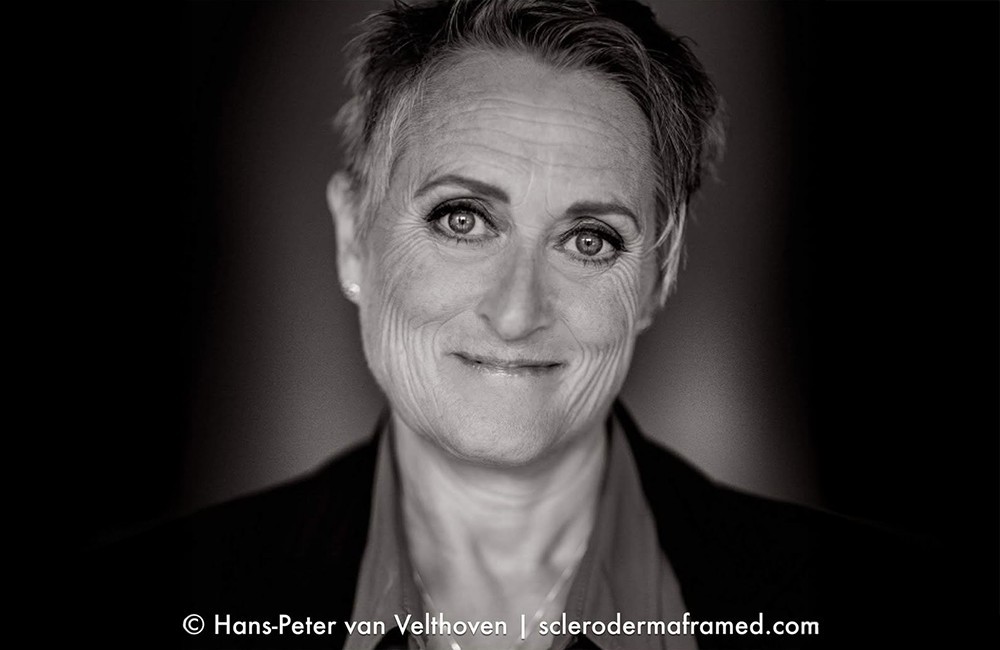
Monique, one of our Scleroderma Framed models, tells her story:
In 2010, I developed severe lung problems. The pulmonologist I saw immediately realised it was serious and did everything in their power to find out what was wrong as quickly as possible. After having been diagnosed with pulmonary fibrosis — its cause had not yet been identified at the time — I was immediately referred to a senior pulmonologist at the University Medical Centre, where the option of a transplant was also discussed straight away. However, once it was established that my pulmonary fibrosis was caused by systemic sclerosis, other options and treatment possibilities became available as well. Unfortunately, these are treatments that can only slow down the process, although we have been able to significantly delay the need for a transplant in this way.
And then there was this moment when the pulmonologist, after consulting with a whole team of bright minds, said that the screening really did need to go ahead now, because otherwise it might be too late. By January 2018, I was mentally ready to enter this stage of the process.
Once it was clear that I was a suitable candidate for a transplant, we decided together to postpone my placement on the list for a while. I wasn't wholly prepared to give up my freedom yet. In December 2018, I was finally placed on the list, and now the challenge remains to stay as physically and mentally strong as possible. Physically, to be ready for a major operation and a gruelling rehabilitation process. Mentally, to continue finding happiness in the smallest things and to have some quality of life. But also to be able to cope with the setbacks that have come my way and definitely will happen in the future as well.
On the transplant waiting list during the COVID-19 pandemic
Fear is setting in all around us. I let it wash over me, and after a while I am able to filter out what's important for me. Being outdoors, exercising, healthy eating, connecting with friends online and a very small circle of people around me offline. But months without going to physiotherapy to keep the tension and pain of scleroderma under control is taking its toll. And there is no strength training either, which is essential for pumping as much oxygen as possible through my body.
No hospital checks to determine whether my condition has deteriorated (as indicated by the corresponding LAS score). If I contract COVID-19, I will be temporarily be removed from the list. There were far fewer transplants in March and April, causing the waiting list to grow. And then there is the issue that it remains to be seen whether the lungs of people who have had mild or severe COVID-19 symptoms will still be suitable for transplantation.
Right now, I am able to live my life with confidence and to take responsibility for my own health, not letting fear get the better of me, and focusing on positive things and possibilities. This mindset is essential to me because it means better quality of life.
In the midst of the COVID-19 pandemic it was suggested to me that I could take part in a (political) campaign in which the new Organ Donation Act was a key issue. I agreed to do so because I'm happy to lend my voice and face to raising awareness. In my case, an additional consideration was that when I'm not using my oxygen, nobody can tell I'm ill.
Immediately afterwards, I was approached by the Dutch public broadcasting TV programme "The 100" – Waiting for a Donor. I felt I simply had to participate in this programme. I was given de opportunity to work on the programme trailer and a number of testimonials. The programme offered a glimpse into the lives of people on the transplant waiting list. It covered small and large hurdles they faced in their daily lives. It was a high-quality programme of integrity, free from sensationalism and based on facts.
My participation in the first episode of "The 100" has already generated a great deal of awareness. Since then, I've had many conversations and, fortunately, have been able to answer many questions. I also discovered that for many people, the need for organ donation only really hits home when they know someone close to them who is waiting for an organ. This came as a shock to me, and it is partly for this reason that I am committed to continue working to raise awareness.
There is still far too little awareness about becoming a donor (or not). In my view, people can only make an informed choice if they know enough about what is important to them. Information is therefore essential, as well as sharing their thoughts. And the most important step is that they share their decision with their loved ones.
In 2010, I developed severe lung problems. The pulmonologist I saw immediately realised it was serious and did everything in their power to find out what was wrong as quickly as possible. After having been diagnosed with pulmonary fibrosis — its cause had not yet been identified at the time — I was immediately referred to a senior pulmonologist at the University Medical Centre, where the option of a transplant was also discussed straight away. However, once it was established that my pulmonary fibrosis was caused by systemic sclerosis, other options and treatment possibilities became available as well. Unfortunately, these are treatments that can only slow down the process, although we have been able to significantly delay the need for a transplant in this way.
And then there was this moment when the pulmonologist, after consulting with a whole team of bright minds, said that the screening really did need to go ahead now, because otherwise it might be too late. By January 2018, I was mentally ready to enter this stage of the process.
Once it was clear that I was a suitable candidate for a transplant, we decided together to postpone my placement on the list for a while. I wasn't wholly prepared to give up my freedom yet. In December 2018, I was finally placed on the list, and now the challenge remains to stay as physically and mentally strong as possible. Physically, to be ready for a major operation and a gruelling rehabilitation process. Mentally, to continue finding happiness in the smallest things and to have some quality of life. But also to be able to cope with the setbacks that have come my way and definitely will happen in the future as well.
On the transplant waiting list during the COVID-19 pandemic
Fear is setting in all around us. I let it wash over me, and after a while I am able to filter out what's important for me. Being outdoors, exercising, healthy eating, connecting with friends online and a very small circle of people around me offline. But months without going to physiotherapy to keep the tension and pain of scleroderma under control is taking its toll. And there is no strength training either, which is essential for pumping as much oxygen as possible through my body.
No hospital checks to determine whether my condition has deteriorated (as indicated by the corresponding LAS score). If I contract COVID-19, I will be temporarily be removed from the list. There were far fewer transplants in March and April, causing the waiting list to grow. And then there is the issue that it remains to be seen whether the lungs of people who have had mild or severe COVID-19 symptoms will still be suitable for transplantation.
Right now, I am able to live my life with confidence and to take responsibility for my own health, not letting fear get the better of me, and focusing on positive things and possibilities. This mindset is essential to me because it means better quality of life.
In the midst of the COVID-19 pandemic it was suggested to me that I could take part in a (political) campaign in which the new Organ Donation Act was a key issue. I agreed to do so because I'm happy to lend my voice and face to raising awareness. In my case, an additional consideration was that when I'm not using my oxygen, nobody can tell I'm ill.
Immediately afterwards, I was approached by the Dutch public broadcasting TV programme "The 100" – Waiting for a Donor. I felt I simply had to participate in this programme. I was given de opportunity to work on the programme trailer and a number of testimonials. The programme offered a glimpse into the lives of people on the transplant waiting list. It covered small and large hurdles they faced in their daily lives. It was a high-quality programme of integrity, free from sensationalism and based on facts.
My participation in the first episode of "The 100" has already generated a great deal of awareness. Since then, I've had many conversations and, fortunately, have been able to answer many questions. I also discovered that for many people, the need for organ donation only really hits home when they know someone close to them who is waiting for an organ. This came as a shock to me, and it is partly for this reason that I am committed to continue working to raise awareness.
There is still far too little awareness about becoming a donor (or not). In my view, people can only make an informed choice if they know enough about what is important to them. Information is therefore essential, as well as sharing their thoughts. And the most important step is that they share their decision with their loved ones.